3 min read
Age-Appropriate Chore Chart for Kids
Which chores suit kids aged 2 to 15, how to set up a chore chart they’ll actually follow, and how points and rewards keep it going past week three.
Quick answer
Give each child two to four jobs a day that suit their age: at 2–3, toys in the basket; at 4–5, setting the table; at 8–9, loading the dishwasher; by 13–15, their own laundry and a family meal. Give harder jobs more points and agree the rewards up front, so the chart lasts past week three.

A chore chart works when every job on it is one your child can actually finish. Too easy and it feels pointless; too hard and it turns into you doing it with them, every time. Start from their age, then adjust to the child in front of you.
Chores by age
| Age | Chores they can usually do |
|---|---|
| Ages 2–3 | Put toys in a basket, put dirty clothes in the laundry, wipe up small spills, help feed a pet. |
| Ages 4–5 | Make their bed (roughly), set the table, water plants, match socks. |
| Ages 6–7 | Sort laundry by colour, put away the cutlery, sweep a small floor, pack their school bag. |
| Ages 8–9 | Load the dishwasher, take out the recycling, fold laundry, help cook a simple meal. |
| Ages 10–12 | Clean the bathroom sink and mirror, vacuum a room, wash dishes, cook a simple dinner with an adult nearby. |
| Ages 13–15 | Do their own laundry, clean the whole bathroom, cook a family meal, mow the lawn. |
These are typical ranges, not rules. Kids can usually keep doing the jobs from younger ages too, so the list grows as they do.
How to set up the chart
- Pick two to four jobs per child per day. More than that and the chart turns back into nagging.
- Write each job as steps they can see finished: “bed made, pyjamas under the pillow”, not “tidy your room”.
- Give longer or harder jobs more points, so effort counts, not just the number of ticks.
- Agree the rewards before you start, and let your child choose some of them.
- Rotate the jobs nobody likes between siblings each week, so it stays fair.
Keep it going past week three
Most fridge charts fade within a few weeks: nobody updates them, they can’t send a reminder, and the stickers stop being exciting. Why paper chore charts fail (and what works)
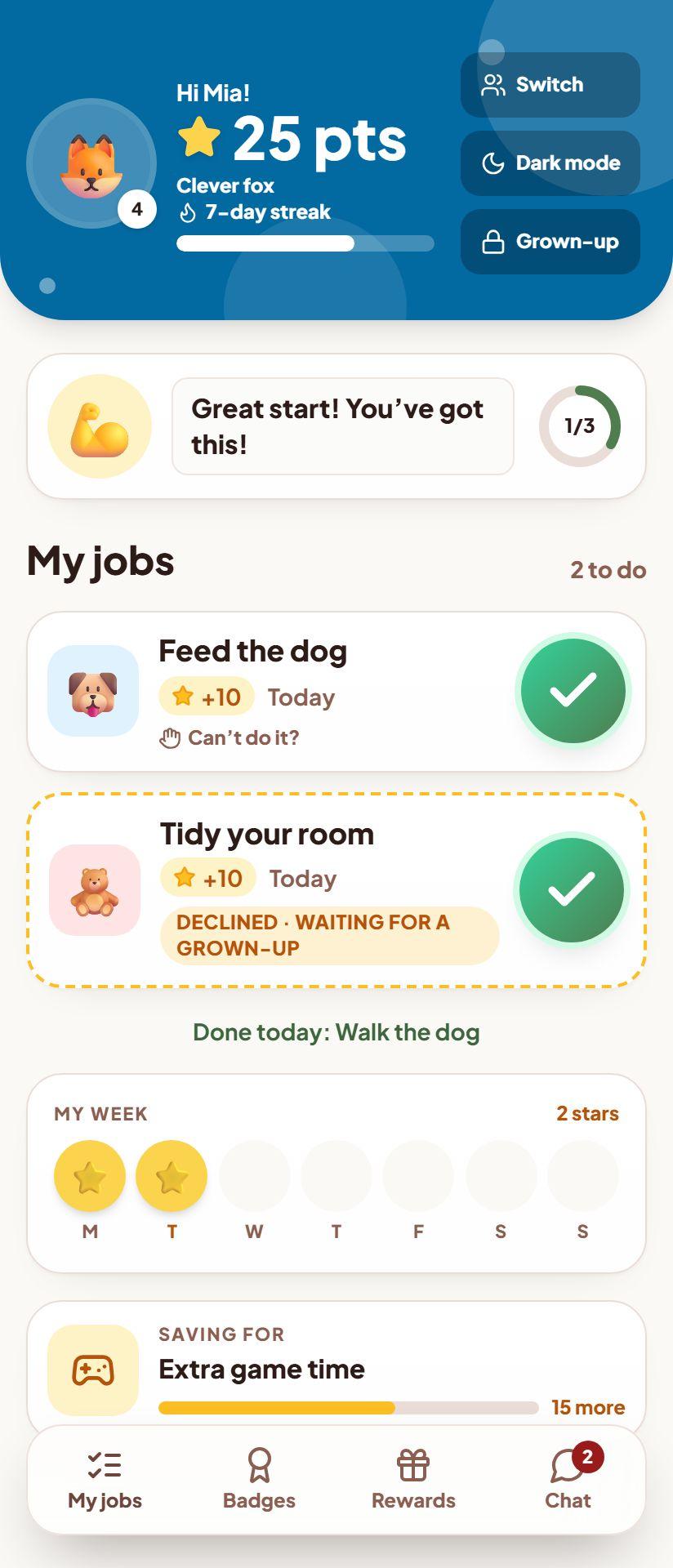
An app keeps the chart on a phone or a kitchen tablet, does the reminding for you and adds up the points by itself. In Harmony, kids get their own kid mode with a PIN, stars, streaks and levels, and spend their points in a reward store that you approve. See Harmony for families
Related guides
Put this into practice with Harmony
Fair chore rotation, a shared grocery list, and meal planning — free to start, set up in under a minute.
Get started free